Local Name
Manch’k’vala (1), Mach’k’unara (rach.), Manch’k’vara, Mach’unk’ala (lech., z. imer.), Manch’k’ora (gur.) (2), Mach’k’unara (rach.) (3), Munch’k’urua (meg.) (4), Manch’k’varai (svan.) (5), Manch’k’varai (svan.) (6).
Description
Cap: The cap is 3–10 cm across, convex to broadly convex or flat in age, the margin often arched in maturity, dry or tacky, color extremely variable, but typically honey yellow, smooth, or with a few tiny, dark scales concentrated near the center and vaguely radially arranged. Gills are attached or beginning to run down the stem, nearly distant, whitish, sometimes bruising or discoloring darker. Stem: The stem is 5–10 cm tall, 0.5–2 cm thick, tapering to base due to clustered growth pattern, tough and fibrous, smooth and pale near apex, darker and nearly hairy below, with a persistent ring at maturity and a white partial veil covering the gills when young. Flesh: The flesh is white or whitish, taste mild, odor sweet. Spores: The spores are 7–8.5 X 6–7.5 µm, broadly ellipsoid to subglobose, colourless or pale white.
Habitat: In dense clusters on or around trunks or stumps of deciduous and coniferous trees. Season: Summer to early winter.
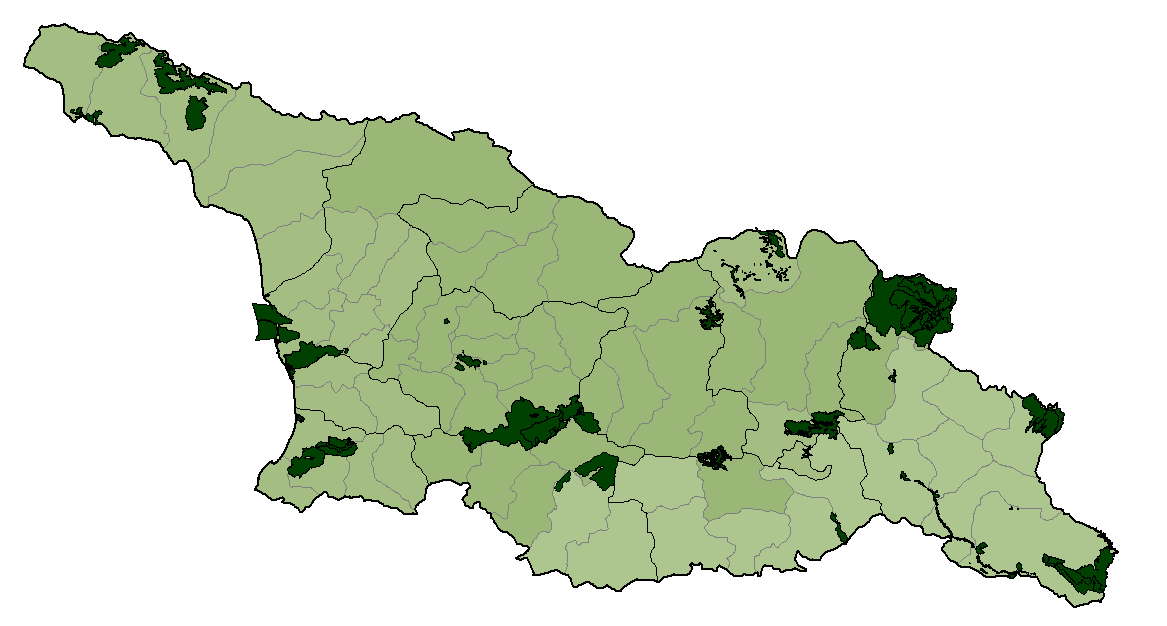
Distribution: All regions of Georgia (7).
Uses
Edibility: Edible when cooked (must be eaten in small amounts as some forms are known to cause stomach upsets) (1).
Imereti — “Usually we pickle them to store for the winter” (8). Kakheti — “I gather these mushrooms (Manch’k’vala) to marinate them and usually I store them for the winter” (9). Kartli — “For the winter we store only these mushrooms” (10). Guria — “These mushrooms (Mach’ink’ora) typically appear in large clusters at the base of a nut tree and also on the logs. But it is possible to meet also a false Mach’ink’ora mushroom: so you must be careful of the dangerous double” (11), “It’s a name of an edible mushroom, some dry them to store for the winter” (12). Svaneti — “Locals gather these mushrooms (Manch’k’vala) in summer and dry them to store. In the winter they make soup with dried mushrooms and eat” (6). Racha — “Mach’k’unara is an edible mushroom, so we gather, clean, dry them on the sun and store them for the winter” (3).
Note: Manch’k’vala is a well known edible mushroom in all the regions of Georgia and locals gather them everywhere.
References
- Nakhutsrishvili, I.G. (2007) Fungi of Georgia. Tbilisi: Buneba Printi.
- Makashvili, A. (1991) Botanical Dictionary. Tbilisi: Metsniereba.
- Kobakhidze, A. (1987) Dictionary of the Rachan Dialect. Tbilisi: Metsniereba.
- Kobalia, A. (2010) Megrelian Dictionary. Tbilisi: Artanuji Publishing.
- Oniani, A. (1917) Collection of Svanetian Names of Trees and Shrubs (on Lashkhuri Dialect), Materials on Japhetic linguistics. Vol. VIII. Petrograd: Academy of Sciences Press.
- Dondua, Karpez (2001) Selected Works. Tbilisi: Metsniereba.
- Nakhutsrishvili, I.G., et al. (1986) Flora of Spore-producing Plants of Georgia (Summary). Tbilisi: Metsniereba (Russian).
- Tkabladze, I. (2016) Vlg. Kumistavi, Tskaltubo.
- Sulashvili, N. (2015) Lagodekhi.
- Dzaganashvili, M. (2015) Vlg. Zakaro, Mtskheta.
- Khukhunaishvili, T. (2016) Lanchkhuti.
- Zhghenti, S. (1936) Gurian dialect. Tiflis: Publishing House of the Georgian Branch of the Academy of Sciences of the USSR.