Local Name
Niq’vi (1), Sokots’itela (imer.), Sokokvertskha (gur.) (2), Malkvala, Sokots’itela (3), Markvalish (megr.), Pipi (megr.) (4), Markvala (gur.) (5), Neq’v (svan.) (6).
Description
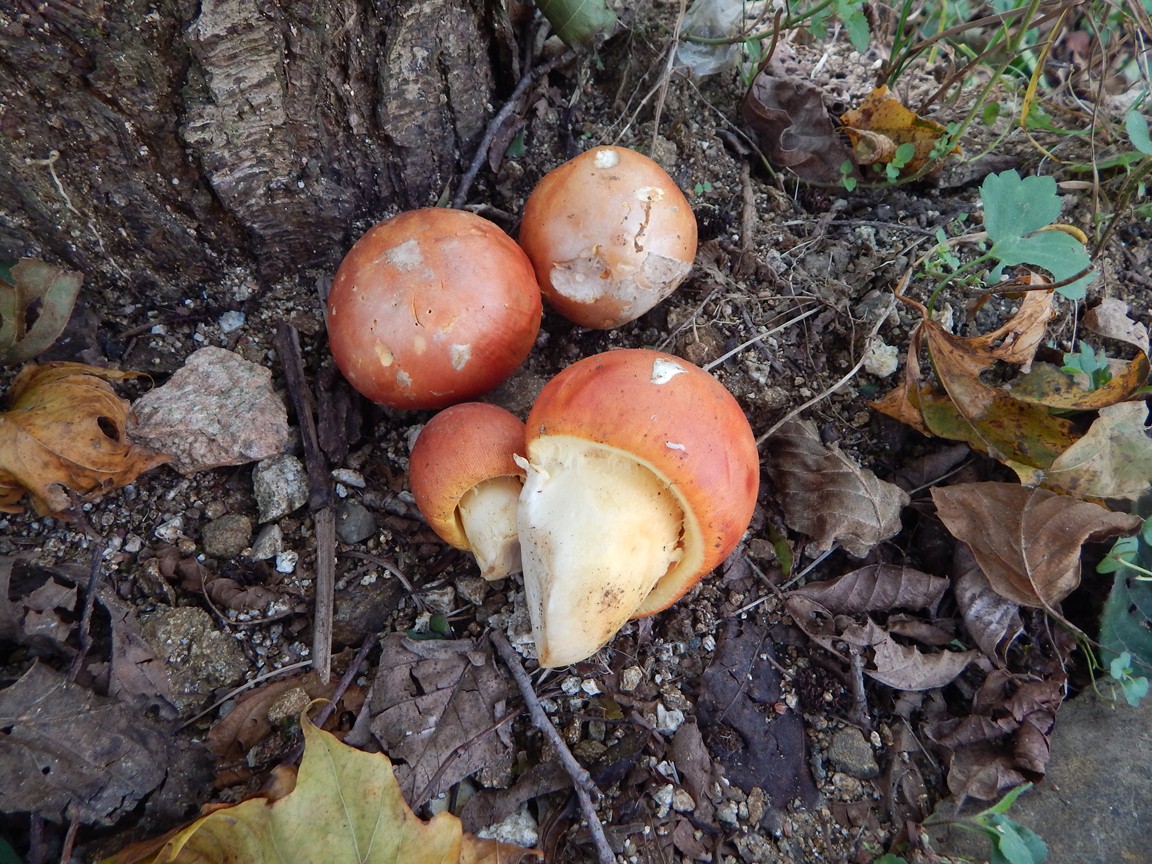
Cap: The cap is 8–20 cm across, ovoid or hemispherical becoming expanded convex, clear orange-red, fading or ageing more yellowish, smooth and slightly viscid, finely lined at the margin. Gills are free and crowded, yellow. Stem: The stem is 8–14 cm tall, 2–4 cm thick, yellow with a large yellow pendulous ring which is often striate, the basal bulb is encased in a large, white bag-like volva. Flesh: The flesh is white or whitish, distinctly yellow below the cap cuticle. Spores: The spores are 9–13 X 5–10 µm, broad elliptical, brownish.
Habitat: On soils, in mountain meadows (subalpine areas). Season: Summer, autumn.
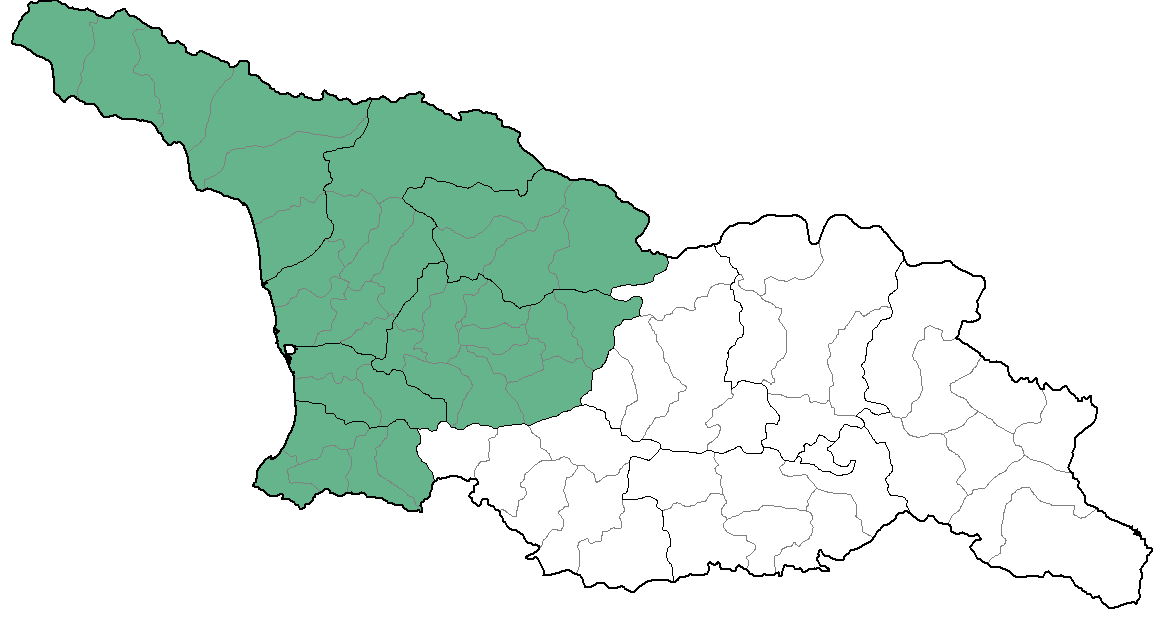
Distribution: Western Georgia (7).
Uses
Edibility: They are considered one of the best of the edible fungi, usually when they are fresh (1).
Imereti — “I hunt and gather these mushrooms (Niq’vi), although usually it’s hard to find them. But if the amount of them is quite large then I fry them in oil with onion. It’s also my favorite way to store mushrooms for the winter” (8), “Even if nobody will be able to find these mushrooms (Niq’vi) in the whole region of Imereti, in the Village Rtskhilati (Chiatura Municipality), however, I’m sure you will find them” (9). Racha — “When the amount of these mushrooms is quite large we dry them, to store for the winter, because one of the good ways to keep mushrooms around is to dry them” (10). Guria — “At first Niq’vi is roundish, reddish, then becomes flat” (11). Kartli — “Niq’vi is very rare in our region, although, I know that these mushrooms are very appetizing and taste wonderful” (12). Kakheti — “Sometimes you can find Niq’vi here, but in very small amount, this is the “King” of the mushrooms” (13), “Mainly Niq’vi can be found in Western Georgia, but there are a few places, where sometimes you can also find them here” (14).
Note: Niq’vi is well known in almost every region of Georgia and is considered by many as the most delicious and tasty mushroom. Niq’vi is often called the “King” of the mushrooms.
References
- Nakhutsrishvili, I.G. (2007) Fungi of Georgia. Tbilisi: Buneba Printi.
- Makashvili, A. (1991) Botanical Dictionary. Tbilisi: Metsniereba.
- Orbeliani, Sulkhan-Saba. (1991) Georgian Dictionary. Tbilisi: Merani.
- Kobalia, A. (2010) Megrelian Dictionary. Tbilisi: Artanuji Publishing.
- Tandilava, A. (2013) Laz Dictionary. Tbilisi: Publishing House Saari.
- Oniani, A. (1917) Collection of Svanetian Names of Trees and Shrubs (on Lashkhuri Dialect), Materials on Japhetic linguistics. Vol. VIII. Petrograd: Academy of Sciences Press.
- Nakhutsrishvili, I.G., et al. (1986) Flora of Spore-producing Plants of Georgia (Summary). Tbilisi: Metsniereba (Russian).
- Tkabladze, I. (2016) Vlg. Kumistavi, Tskaltubo.
- Kupatadze, Z. (2016) Chiatura.
- Melashvili, N. (2014) Vlg. Uravi, Ambrolauri.
- Ghlonti, M. (2016) Lanchkhuti.
- Modzghvrisshvili, G. (2015) Vlg. Saguramo, Mtsketa.
- Chaduneli, Z. (2015) Vlg. Gurgeniani, Lagodekhi.
- Brekashvili, L. (2015) Vlg. Zemo Bodbe, Sighnaghi.