Local Name
Kveq’nis gula, sadmamglije (javakh., kakh.), Mutselgvremia (imer.) (1), Kueq’nis-Guli (2).
Description
Fruit body: The fruitbody is 5–6 cm across, like a whitish to yellowish “egg”, usually at least partly submerged in the ground, when sliced revealing the stinkhorn-to-be encased in a gelatinous substance. Mature Fruiting Body: Spike-like, to 20 cm high, with a cap 4-6 cm wide, which is covered with olive brown to dark brown slime, often developing a perforation at the tip. Cap: The cap is 4–5 cm tall, bell-shaped, the cap surface pitted and ridged beneath the slime, sometimes with a whitish to purplish “skullcap”, with carrion smell. Stem: The stem is 1–3 cm thick, whitish, hollow, the base enclosed in a white sacklike volva, which is often at least partly submerged underground. Spores: The spores are 3,5–5 X 1,5–2 µm, elliptical or oblong, smooth, with yellowish tinge.
Habitat: On soils, amongst grass on lawns, meadows and pasturelands, cultivated areas, in leafy forests (often in beech forest), also on the edges of forests. Season: Summer, autumn.
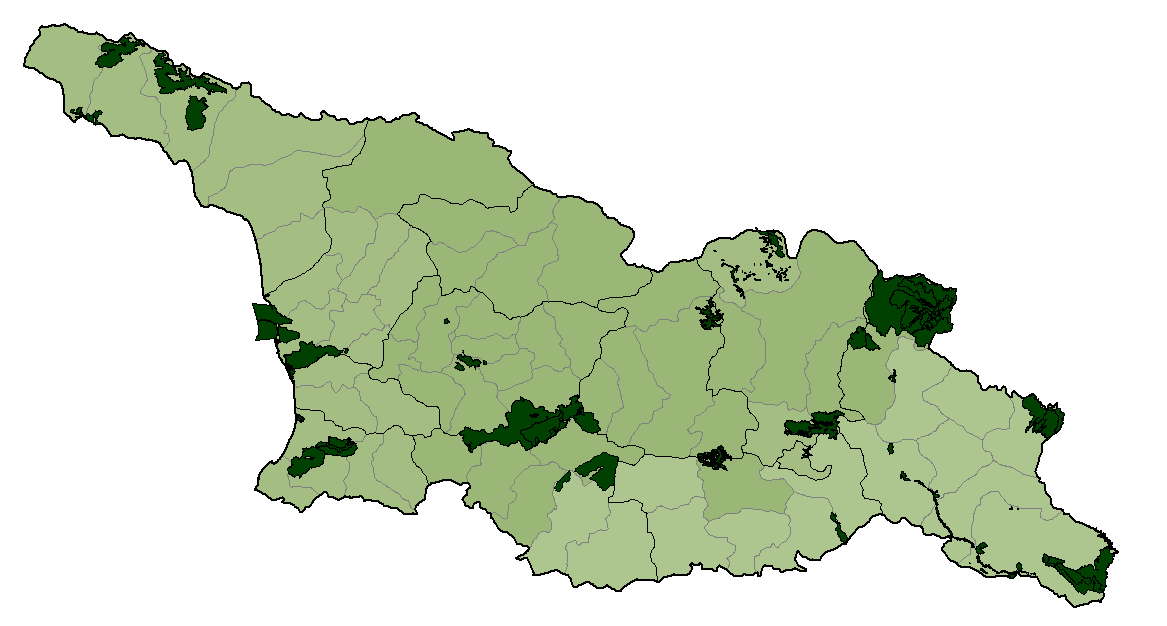
Distribution: All regions of Georgia (3).
Uses
Edibility: Edible when young and fresh (1).
Kakheti — “Kveq’nis gula is a fungilike plant, pinkish, usually appears in the early spring, its root is looks like a ball underground, and also like an albumen under the derma, used for treatment of a heart pain” (4). Pshavi — “Kveq’nis gula it’s a name of the fungi, usually appears in the forest, on reiny days, shaped like an apple, same size, with squeaking smell, flesh is jellylike, locals peel them and eat. There is another variety of this fungi, which is narrow and reversed, looks like a tall cup, pure white, with holes, sometimes locals fill this fungi with strawberries and eat so (5). Dusheti — “As I remember from my childhood, my foster mother used this fungi for treatment of a quinsy, before the fungi was egg-shaped, she was peeling off the fungi’s skin and we were swallowing the whole of the fungi” (6). Imereti —”When the fungi is egg-shaped, I gather and dry them on the sun, then mill and store the powder, then I mix the small portion of this powder with water to use for treatment of a fright neurosis” (7). Tetritskaro — “When the fungi are egg-shaped, I gather and put them into the vinegar for two weeks and keep them on sunny place, then take out from vinegar and dry them on the sun for a quite long time, then mill and store the powder, when a heart attack disturbs me, I take the powder by the tip of the knife, then mix it with the water and then drink this mixture, I learnt from my grandmother to how to use this mixture” (8).
References
- Nakhutsrishvili, I.G. (2007) Fungi of Georgia. Tbilisi: Buneba Printi.
- Orbeliani, Sulkhan-Saba (1991) Georgian Dictionary. Tbilisi: Merani.
- Nakhutsrishvili, I.G., et al. (1986) Flora of Spore-producing Plants of Georgia (Summary). Tbilisi: Metsniereba (Russian).
- Menteshashvili, S. (1943) Kizikian Dictionary. Tbilisi. Publishing House of the Academy of Sciences of the Georgian SSR.
- Khornauli, G. (2000) Pshavian Dictionary. Tbilisi: Chronograph.
- Bulalauri, P. (2014) Vlg. Bulachauri, Dusheti.
- Angelina. (2016) Vlg. Chashora, Sachkhere.
- Tsiklauri, M. (2004) Manglisi.