
Local Name
Tetri ts’erosts’viva (1), Mgzavrio, Ts’erets’o, Ts’eresto (zem. imer.), Q’achamaghala, K’anchmaghala (lechkh.), Ts’eresto, Ts’oropsua (okr.), Ts’orosts’ivi, Ts’vivosts’viva (adjar.) (2), Ts’eros ts’viva, Ts’era-Ts’ua (pshav.) (3), Ts’erosh bok’o (megr.) (4), Ts’orasts’o (kiz.) (5), Viji korgol (svan.) (6).
Description
Cap: The cap is 5–12 cm, ovate at first then convex and slightly umbonate, covered in fine adpressed ochre-buff scales on a white ground. Gills are free from the stem, frequent, white or whitish, then pale cream or darker, sometimes yellowing somewhat with age. Stem: The stem is 6–12 cm long, 0.6–1.2 cm thick, cylindrical, hollow, slightly thickened at the base, smooth, white, ring narrow and persistent. Flesh: The flesh is white or whitish, not changing when sliced, sometimes with pleasant odor and slightly bitter taste. Spores: The spores are 12–15 X 8–9 µm, elliptical or egg-shaped, pure white or colorless.
Habitat: On soils, in gardens, on the roadbeds, paths, on meadows, grasslands, pastures, on the edges of forests and so on. Season: Summer, autumn.
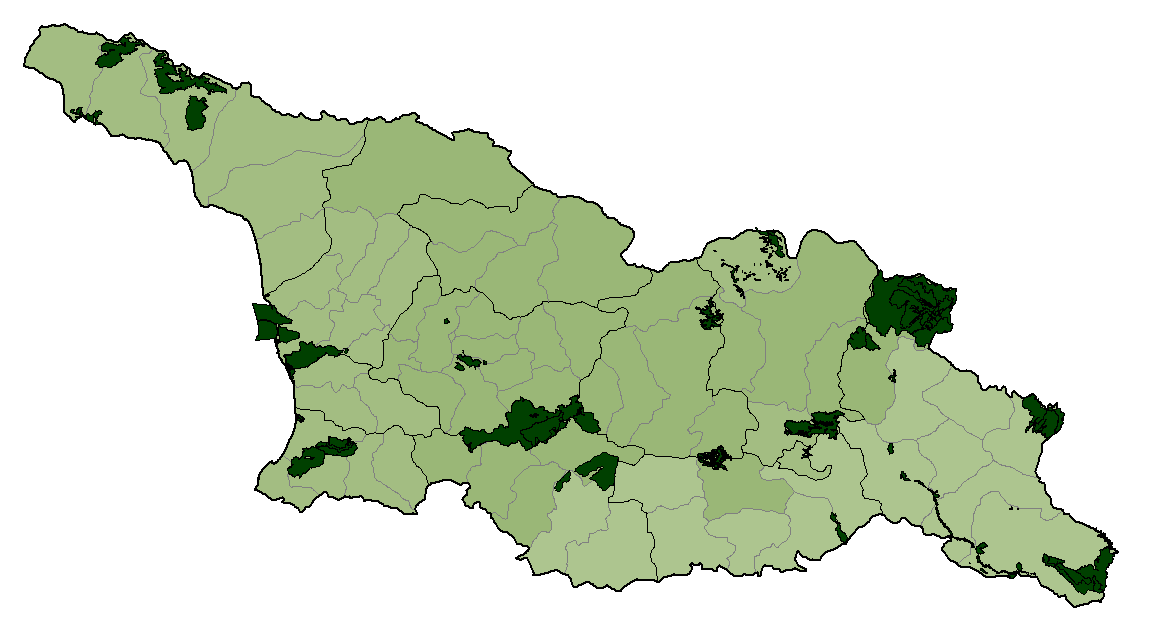
Distribution: All regions of Georgia (7).
Uses
Edibility: Edible when young, fresh and dry (1).
Pshavi — “You can find these mushrooms on virgin soils as well as on places where manure is mixed with soil, often in autumn rainy weather” (3). Imereti — “You can definetely find these mushrooms on the roadbeds” (5). Svaneti — “These mushrooms are edible, and grow on soils, they’re look like umbrellas” (6). Tusheti — “We gather Ts’erosts’viva mushrooms, they’re tasty” (8). Kakheti — “Ts’erets’o is a very tasty, white and speckled mushroom” (9).
Note: Tetri ts’erosts’viva — is a well known mushroom, so people gather this mushroom in all regions of Georgia, they use only one name for all of the species of Macrolepiota, and all the species are used as food.
References
- Nakhutsrishvili, I.G. (2007) Fungi of Georgia. Tbilisi: Buneba Printi.
- Makashvili, A. (1991) Botanical Dictionary. Tbilisi: Metsniereba.
- Shanidze, A. (1984) Georgian mountain dialects. Collected Works in Twelve Volumes. Vol. I. Academy of Sciences of the Georgian SSR. Tbilisi State University. Tbilisi: Metsniereba.
- Kobalia, A. (2010) Megrelian Dictionary. Tbilisi: Artanuji Publishing.
- Ghlonti, A. (1974) Dictionary of the Georgian Dialects. Vol. I. Tbilisi: Ganatleba.
- Oniani, A. (1917) Collection of Svanetian Names of Trees and Shrubs (on Lashkhuri Dialect), Materials on Japhetic linguistics. Vol. VIII. Petrograd: Academy of Sciences Press.
- Nakhutsrishvili, I.G., et al. (1986) Flora of Spore-producing Plants of Georgia (Summary). Tbilisi: Metsniereba (Russian).
- Asabashvili, P. (2014) Vlg. Omalo, Tusheti.
- Brekashvili, L. (2015) Vlg. Zemo Bodbe, Sighnaghi.